01
Explain
Why approachable artwork is a requirement of public signage, not a decoration.
Hydrants, defibrillator cabinets and shelter signs, read by strangers of every age - and wording that can be corrected after it is printed.
 ResQ-R
The second perspective: public infrastructure, an audience of strangers, and safety copy that stays correct for as long as the paper lasts.
 ResQ-R
ResQ-R
ResQ-R
A safety message nobody reads has exactly the same effect as no safety message. Being approached is the feature.
ResQ-R
 ResQ-R
ResQ-R
ResQ-R
If that object could say one sentence, what should it be?
ResQ-R
The second perspective is the one the project is named for. Public infrastructure is everywhere and almost entirely unexplained. A fire hydrant is a lump of metal that children are told not to sit on. A defibrillator cabinet on a wall is, to most people, a mysterious green box they would not open under any circumstances, including the exact circumstances it exists for. A storm shelter sign points at a door. None of these things teach anybody anything, and all of them are in places where thousands of people walk past every week. That is an enormous amount of unused teaching surface, and unlike a classroom it reaches the people who never come to the open day.
Three things. First, you will be able to explain why the artwork on the badge is a design requirement rather than a decoration, in terms of who actually approaches a sign. Second, you will be able to explain what it means that the content resolves live, and what a fire service can therefore do that it could not do with printed signage. Third, you will be able to plan a first batch of public badges: what to badge first, who writes the words, and what to do about the fact that different readers need different words.
Here is the uncomfortable fact about safety signage. It is written to discharge a duty, not to be read. It is correct, it is compliant, it is in the right place, and it is invisible - people walk past a hazard placard every day for years and could not tell you what colour it is. Now consider what a child does when they see a cartoon dog in a fire helmet. They go and look. They ask what it is. They point a phone at it, or they make an adult do it. That is not a small difference in engagement, it is the difference between zero and something, and it is the reason the artwork is not negotiable. A safety message nobody reads has exactly the same effect as no safety message. Approachability is the feature.
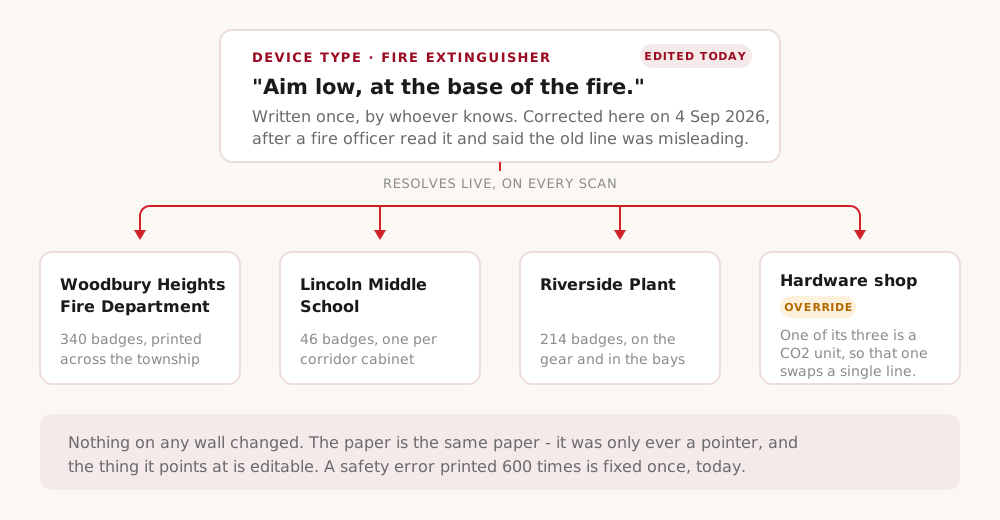
And here is what a public agency gets that it has never had before. The wording lives on a device type, and every badge tagged with that type resolves its wording live, on every scan. So when a fire officer reads a line on the extinguisher page in September and says that is misleading, somebody edits it, and every badge in the district is corrected the same afternoon. Not the ones printed after today - all of them, including the six hundred already stuck to walls in schools and stairwells and church halls. Nothing is reprinted, nothing is replaced, and nobody drives anywhere. Think about what that is worth against a printed sign, where a wording error is permanent until somebody funds a reprint. And where the standard wording genuinely does not fit one object, that single badge can override the one field that is wrong and keep everything else, so it still groups and reports as what it is.
Planning a first public batch, in four steps. Start by choosing what to badge, and choose by footfall rather than by importance - the hydrant outside the primary school teaches more people in a week than the one on the industrial estate teaches in a year. Then decide who writes. The words are a public safety statement from your service, so they should be written or approved by somebody whose job that actually is, and then read out loud to somebody who is not in the fire service, because expert wording is reliably too careful to be useful. Next, mint the batch as blanks: a print-ready sheet with a claim PIN under each badge, so they can be printed now and assigned to specific locations as they go up. Then decide about different readers. One page cannot be written for a nine-year-old and a duty manager at the same time, so where you genuinely need both, that is two badges - a schools batch and an operational batch - not one compromise that serves neither.
Three minutes on your own town. First: name five pieces of public safety equipment within a ten-minute walk of where you are sitting. Most people manage two and are surprised. Second: pick one of them and say honestly what the average passer-by understands about it - not what a professional understands, the passer-by. Third, and this is the one worth writing down: if that object could say one sentence to whoever is standing in front of it, what should the sentence be? Not the manual. One sentence. For a defibrillator cabinet, most services eventually land on something close to open it, the machine talks you through it, you cannot shock somebody who does not need it. That sentence is worth more than the placard currently on the wall.
Three things from the public perspective. Public infrastructure is an enormous unused teaching surface, and it reaches the people who never come to the open day. The artwork is a requirement rather than a decoration, because a message nobody approaches is a message nobody receives. And live content changes what a printed sign is: a wording error stops being permanent, so it becomes reasonable to publish good plain words now and improve them later, rather than waiting for wording that is perfect and therefore never shipping. Next lesson is the same badge again, on a loading dock.